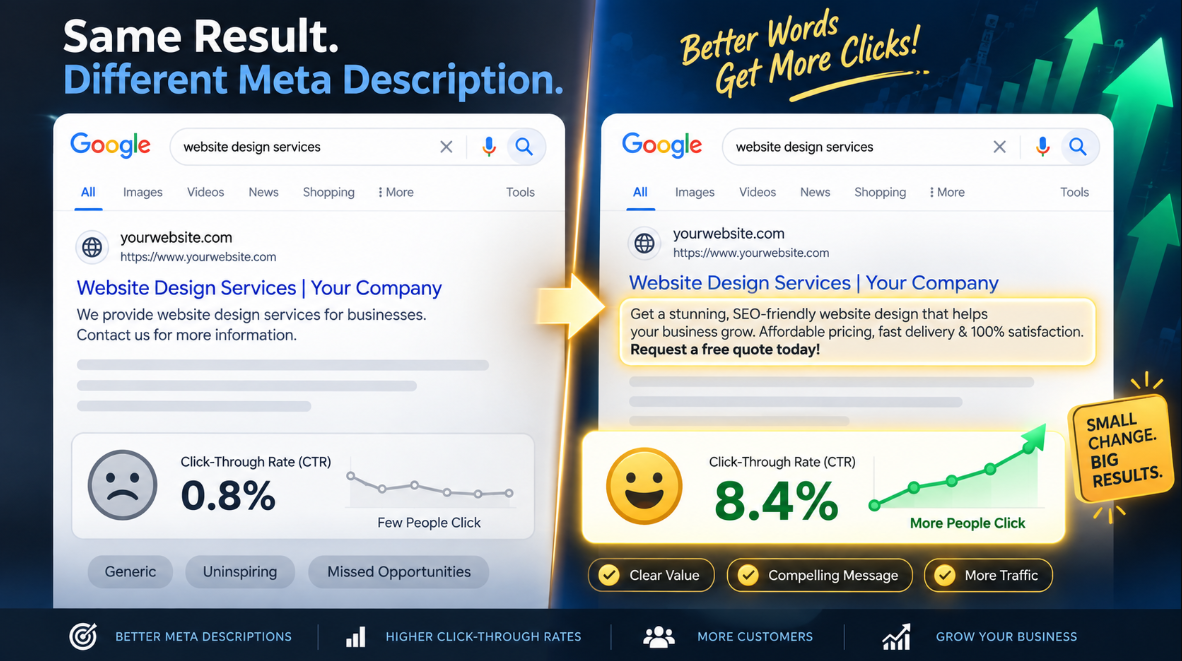
Here's a sobering statistic: the average internet user spends just 8 seconds deciding whether to click on a search result or scroll past it . In that fleeting moment, your blog title, what appears as the clickable headline in search results, makes or breaks that decision.
Your blog title is the gateway to your content. It is the first and most prominent thing a reader sees when deciding whether to navigate to your site . According to one study by Backlinko, the top-ranking result on a Google SERP has an average click-through rate (CTR) of about 27.6%. The link in position two has a CTR of just 15.8% . That's a significant drop, and a key differentiator between those two positions is often the quality and relevance of their headlines.
A slightly more relevant or catchy title can gain you an extra 10 to 12 sessions per 100 users that see your listing. If 4% of your organic sessions convert to sales, the business impact of a better headline becomes clear .
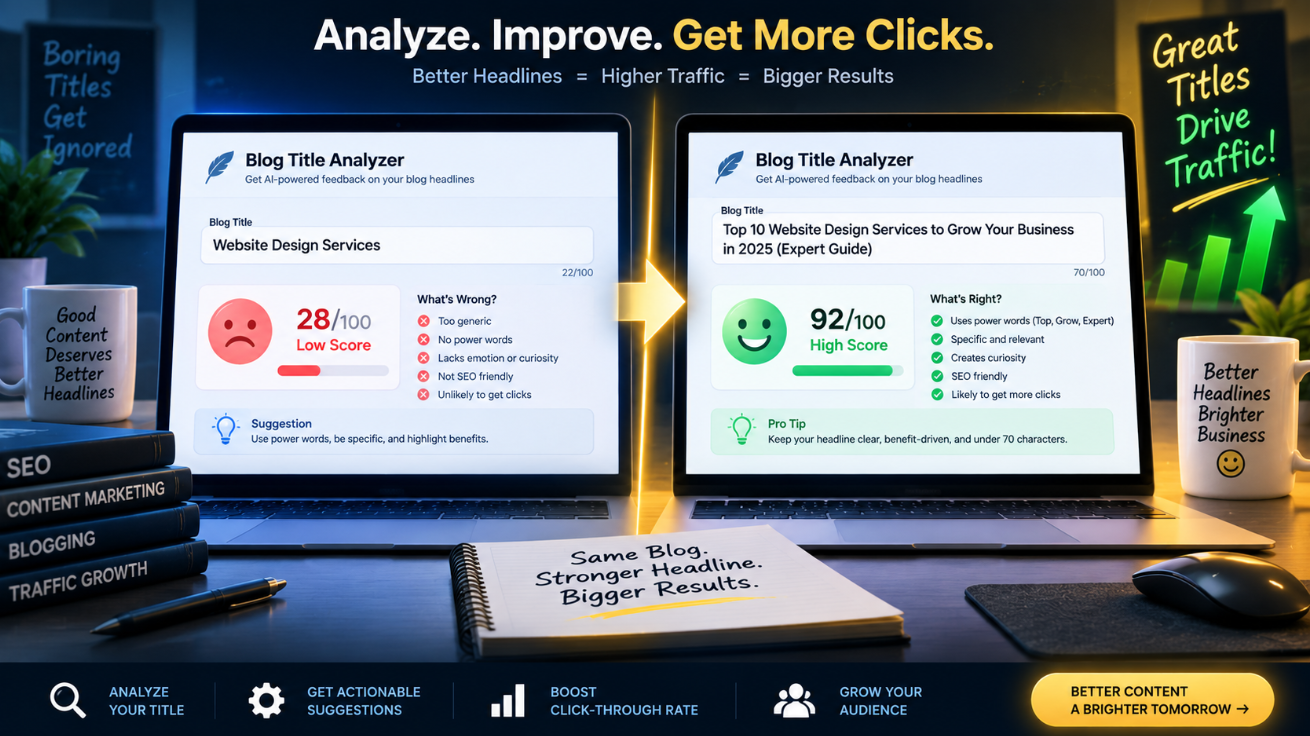
This is where a blog title analyzer becomes an indispensable tool in your SEO and content marketing arsenal.
What Is a Blog Title Analyzer?
A blog title analyzer is a tool that evaluates your proposed headlines based on data-driven criteria. It helps you write headlines that drive more clicks, ROI, and results by seamlessly integrating SEO best practices with human-powered writing expertise .
Key Metrics Analyzed
Most headline analyzers score your title on several dimensions :
| Metric | What It Measures |
|---|---|
| Word Count | The ideal number of words for maximum engagement |
| Character Count | Ensuring your title fits within Google's 50-60 character display limit |
| Word Balance | The mix of common, uncommon, powerful, and emotional words |
| Headline Type | The vibe your headline gives off, testimonial, question, listicle, etc. |
| Reading Grade Level | The difficulty/reading level of your headline |
| Sentiment | The overall feel and attitude of your headline |
| Clarity | How clear and easy to understand your headline is |
| Skimmability | How quickly readers can grasp your headline's meaning |
| SEO Score | How well your headline will rank on search engines compared to competitors |
What Constitutes a Good Score?
Any score within the green zone, typically 70 and higher on a 1-100 scale, is an indicator of a good blog title . The closer to 100, the better. Tools like CoSchedule's Headline Analyzer provide this scoring, along with data-driven suggestions for improvement based on analysis of over 4 million headlines .
Popular Blog Title Analyzer Tools
Several excellent tools can help you craft better headlines. Here are some of the most popular options:
1. CoSchedule Headline Analyzer
CoSchedule offers a free headline analyzer that lets you analyze titles for blog posts, YouTube videos, emails, podcast episodes, TikTok videos, and Instagram posts . It provides a comprehensive list of how your headline is ranked and ways to improve your score for better SEO results .
The tool integrates with Headline Studio, which offers:
Headline AI that generates creative headline options in seconds
Actionable suggestions that tell you exactly how to improve your headline
Competitor analysis showing top-performing headlines in your niche
2. MonsterInsights
MonsterInsights is a Google Analytics plugin for WordPress that includes a free headline analyzer. It helps users create SEO-friendly headlines and provides a list of power words, emotion words, and uncommon words to assist in crafting compelling headlines .
3. AIOSEO
AIOSEO's headline analyzer provides feedback on submitted headlines and suggests improvements. The tool advises users to use powerful words, maintain word balance, convey the right sentiment, keep headlines to six words or fewer, and ensure character count is under 60 for maximum effectiveness .
4. IsItWP
The IsItWP headline analyzer assesses the SEO effectiveness of a title and provides feedback on improvement areas. It analyzes word balance, word count, use of power words and emotional words, and the sentiment triggered by the title .
5. Capitalize My Title
Capitalize My Title offers a headline analyzer alongside other writing resources like a title capitalization tool, word counter, and grammar checker .
How to Use a Blog Title Analyzer Effectively
Step 1: Write Multiple Title Options
Creating titles takes brainstorming. Write several options down and weed them out from there . A useful technique is mixing and matching, take the first half of one title and combine it with the second half of another to create stronger options .
As one professional copywriter's rule of thumb: never use your first headline. Write 10 to 25 variations and pick the strongest one .
Step 2: Analyze Your Best Options
Once you've narrowed down your favorites, run each through your chosen analyzer. Look beyond the overall score, pay attention to specific metrics like word balance, sentiment, and clarity .
Step 3: Optimize Based on Feedback
Use the tool's suggestions to refine your headline. Tools like Headline Studio provide specific recommendations for improvement, such as:
Adding a number to increase scannability
Including a power word to trigger emotional response
Reducing word count for better skimmability
Step 4: Compare Against Competitors
Tools like Headline Studio show you top-performing headlines that compete with yours in search engine results . This helps you see how your headline stacks up and gives you a competitive edge.
Power Words That Boost Headline Performance
Power words are certain words that copywriters use to draw an emotional response from people. They can be used to increase click-throughs on ads, open rates in emails, and response rates on job applications .
Categories of Power Words
Emotional Power Words:
Curiosity and Intrigue Words:
Trust and Authority Words:
Value and Results-Oriented Words:
Classic Power Words That Work
Some classic, foolproof headline words consistently work across industries :
How to
The Truth About
Amazing
Breakthrough
Discover
Confessions of
Pro Tip: Use just 1 to 2 power words per headline. More than that reads as clickbait and can actually reduce trust and CTR .
Common Blog Headline Mistakes That Kill CTR
These mistakes appear in over half the blog posts we audit. Each one reduces CTR and wastes the effort you put into the content below the headline .
Mistake 1: Writing the Headline Last
Most writers draft the article first and add the headline as an afterthought. This is backwards. The headline should guide the content, not summarize it. Write your headline before the article, it focuses your writing and ensures every section supports the promise in the title .
Mistake 2: Being Too Clever
Puns, wordplay, and abstract references reduce clarity. "Planting Seeds of Digital Growth" tells the reader nothing about the content. "How to Grow Organic Traffic in 90 Days" tells them everything. Clarity beats cleverness. Always .
Mistake 3: Keyword Stuffing the Title
"SEO Tools Best SEO Tools for SEO in 2026 SEO Guide" is not a headline, it's keyword spam. Google penalizes it. Readers ignore it. Use your primary keyword once, naturally, in the headline .
Mistake 4: Overpromising
"How I Made $1 Million from One Blog Post" only works if the article proves the claim. Headlines that overpromise and underdeliver increase bounce rate. Google tracks bounce rate as a quality signal. A misleading headline hurts your rankings over time .
Mistake 5: Ignoring the Competition
Your headline appears alongside 9 other titles on page 1. If all 10 headlines say the same thing, none of them stand out. Search the keyword and read competing titles before finalizing yours. Your headline needs to offer something others do not .
Mistake 6: Skipping Numbers When They Fit
"Ways to Improve Your Blog" is weaker than "12 Ways to Improve Your Blog." The number sets expectations and makes the headline scannable. Add numbers whenever your content supports a count .
Mistake 7: Forgetting the Meta Description
The headline and meta description work as a team. A strong headline with a weak meta description loses clicks to a competitor with both optimized. Write them at the same time, they should complement each other, not repeat the same phrase .
SEO Best Practices for Headlines
Character Length Matters
Search engines typically display the first 50-60 characters of a headline. Keeping your headline within this limit ensures it's fully visible in search results .
Use Relevant Keywords
Incorporate keywords that your target audience is likely to search for. These should be relevant to your content and naturally integrated into your headline .
Optimize for Click-Through Rate
An engaging headline encourages users to click when it appears in search results. This can improve your CTR, a factor search engines consider when ranking content .
How to Test Headlines Before Publishing
Writing 10 headline variations is step 1. Testing them is step 2. Data beats opinion every time .
Free Headline Testing Tools
CoSchedule Headline Analyzer: Scores on word balance, length, sentiment, and clarity. Scores above 70 are strong.
Sharethrough Headline Analyzer: Evaluates engagement and impression quality with specific suggestions.
AMI Headline Analyzer: Measures Emotional Marketing Value (EMV), aim for an EMV score above 40% .
A/B Testing Headlines After Publishing
Some platforms allow you to change the title tag after publishing without affecting the URL. If your page ranks but has a low CTR, test a new headline .
How to identify low-CTR pages:
Open Google Search Console
Go to Performance > Search Results
Filter by Pages
Sort by Impressions (descending)
Look for pages with high impressions but low CTR relative to their position
A page in position 3 with 2% CTR is underperforming and needs a headline refresh .
The Connection Between Headlines and Long-Tail Keywords
Long-tail keywords, specific, often 3-4 word phrases, have significantly less competition than short-tail keywords . When you optimize your headlines for long-tail keywords, you're targeting users with stronger purchase intent. The best part: optimizing for long-tail keywords doesn't come at the cost of short-tail keywords. Long-tail phrases naturally include shorter keywords, allowing you to "kill two birds with one stone" .
Conclusion: Your Headline Is Worth the Investment
Your blog title is often the difference between a click and a scroll. It's the gateway to your content, a critical SEO signal, and the first impression you make on potential readers.
Using a blog title analyzer gives you a data-driven edge in a competitive landscape. It helps you:
Identify weaknesses in your headlines before publishing
Find the perfect balance between SEO and human readability
Incorporate power words that drive emotional response
Beat competitors for clicks in search results
The 8-second window is short. But with the right tools and strategies, you can make every second count, and turn browsers into readers, readers into subscribers, and subscribers into customers.
Ready to write headlines that rank and get clicks? Start using free headline analyzer tools to score your blog titles, discover the perfect power words, and dominate search results today.